
-
Archives
- September 2026
- August 2026
- July 2026
- June 2026
- May 2026
- April 2026
- March 2026
- February 2026
- January 2026
- December 2025
- November 2025
- October 2025
- September 2025
- August 2025
- July 2025
- June 2025
- May 2025
- April 2025
- March 2025
- February 2025
- January 2025
- November 2024
- October 2024
- September 2024
- August 2024
- July 2024
- June 2024
- May 2024
- April 2024
- March 2024
- February 2024
- January 2024
- December 2023
- November 2023
- October 2023
- September 2023
- August 2023
- July 2023
- June 2023
- May 2023
- April 2023
- March 2023
- February 2023
- January 2023
- December 2022
- November 2022
- October 2022
- August 2022
- July 2022
- June 2022
- May 2022
- April 2022
- March 2022
- February 2022
- January 2022
- December 2021
- November 2021
- October 2021
- September 2021
- August 2021
- July 2021
- June 2021
- May 2021
- April 2021
- March 2021
- February 2021
- January 2021
- December 2020
- November 2020
- October 2020
- September 2020
- August 2020
- July 2020
- June 2020
- May 2020
- April 2020
- March 2020
- February 2020
- January 2020
- December 2019
- November 2019
- October 2019
- September 2019
- August 2019
- July 2019
- June 2019
- May 2019
- April 2019
- March 2019
- February 2019
- January 2019
- December 2018
- November 2018
- October 2018
- September 2018
- August 2018
- July 2018
- June 2018
- May 2018
- April 2018
- March 2018
- February 2018
- January 2018
- November 2017
- August 2017
- June 2017
- March 2017
- December 2001
-
Meta
Monthly Archives: July 2021
General Assembly day four round up: 12 July 2021
 The Revd Helen Everard, Chaplain to the Moderators of Assembly, led a short session of worship on the last morning of General Assembly.
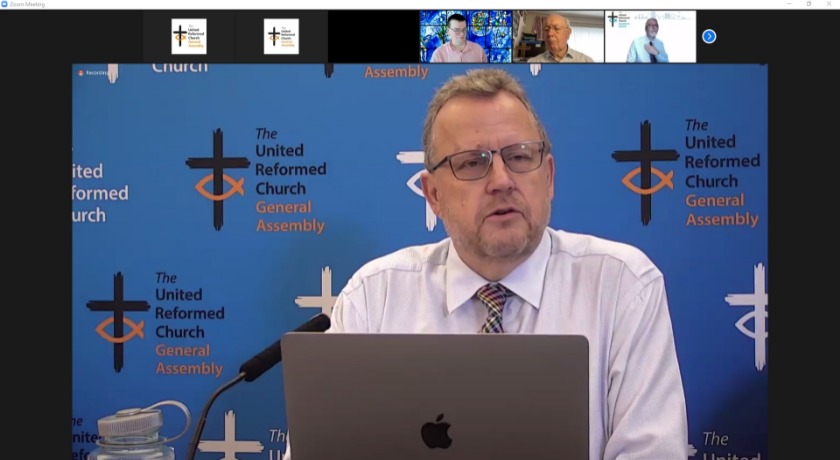
The Convenor of the Business Committee, the Revd Adrian Bulley, announced that contributions from members of Assembly would be reduced from three to two minutes, because of the amount of outstanding business to cover in the remaining sessions.
Posted in Latest News.
Comments Off on General Assembly day four round up: 12 July 2021
Reset the Debt in Parliament
Well over a thousand supporters of the Reset the Debt campaign wrote to their MPs to ask them to attend the debate on household debt in Parliament on 8 May. Thank you! The debate attracted a range of MPs from across the … Continue reading
Posted in Latest News.
Comments Off on Reset the Debt in Parliament
URC passes multiple resolutions about Israel and Palestine
 At its General Assembly, meeting between July 9-12, the United Reformed Church (URC) passed ten significant resolutions pertaining to the situation in Israel and Palestine.
A primary focus of the resolutions deals with the way in which Israeli settlements and forced land acquisitions represent a de facto annexation of the occupied Palestinian territories.
There is a request for local churches and members to contact their constituency MPs to express concerns about the actions of the Israeli government regarding settlement expansion and house demolitions, and to ask what the UK is doing in response.
There is also an appeal to refrain from purchasing products produced in Israeli settlements.
Posted in Latest News.
Comments Off on URC passes multiple resolutions about Israel and Palestine
General Assembly day three round up: 11 July 2021
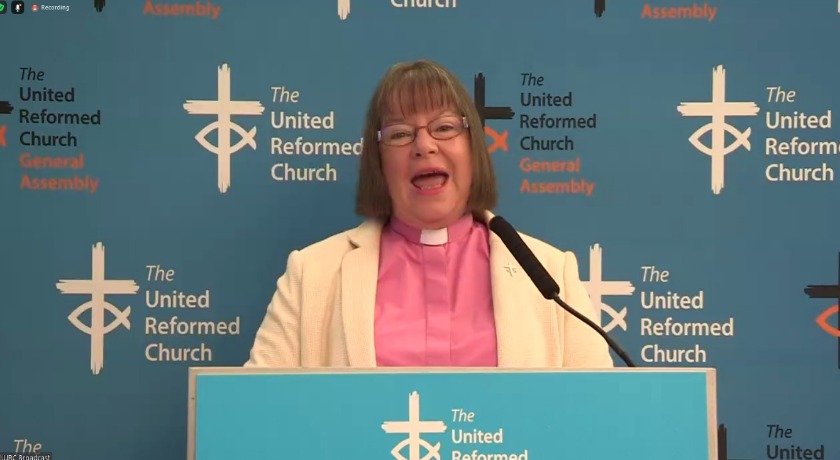 The third day of the United Reformed Church General Assembly, which was held digitally, began with prayer led by the Chaplain to the Moderators, the Revd Helen Everard.
Session nine
Announcement of the Election of General Assembly Moderator 2022-2023
The result of the vote for Moderator of General Assembly was announced by the Revd Adrian Bulley, Convenor Business Committee: 208 votes were cast and the Revd Fiona Bennett, Minister of Augustine United Church, Edinburgh, was elected as Moderator. Mrs Everard led Assembly in prayer for both candidates.
Posted in Latest News.
Comments Off on General Assembly day three round up: 11 July 2021
General Assembly day two round up: 10 July 2021
 The second day of General Assembly began with worship led by the Chaplain to the Moderators, the Revd Helen Everard. The band of Woking URC led Assembly in the hymn ‘All creatures of our God and King’. A number of young people read from Job 12 and Matthew 7.
Opening worship
The Revd David Coleman, Environmental Chaplain of Eco Congregation Scotland, led the Bible study. He asked Assembly which Bible character was mentioned between 800 and 1,000 times, second only to God, one who you deal with daily, depend on, but disregard, who is treated as less than human, but called by God to be a witness. The answer is… the earth.
In Jesus’ story of the two builders, on rock and sand, said Mr Coleman, ‘neither builder could dictate to the wind and rain, but one of them ignored that voice and the other was prepared to be taught and survived.’
It is not idolatrous to revere God’s creation, he said: ‘There is no competition between God and what he has made. Gratitude to the earth is no more inconsistent with the praise of God than honouring our father and mother.’ When we see the harm we are doing, and yet carry on, the heart of God knows sorrow. The earth has God’s attention.
We are told, said Mr Coleman, that acting now, there is scope for a just transition to sustainable living. Are we going to take notice? Being a Christian today, he said, ‘it matters far less whether you are progressive or conservative, as long as you employ empathy and relationship and escape from the idea we own the earth.
Worship concluded with prayers led by young people on video, and the song ‘All through history’, led by the Woking URC.
Session four
Celebration of newly ordained ministers, commissioning of CRCWs and Jubilee Ministers
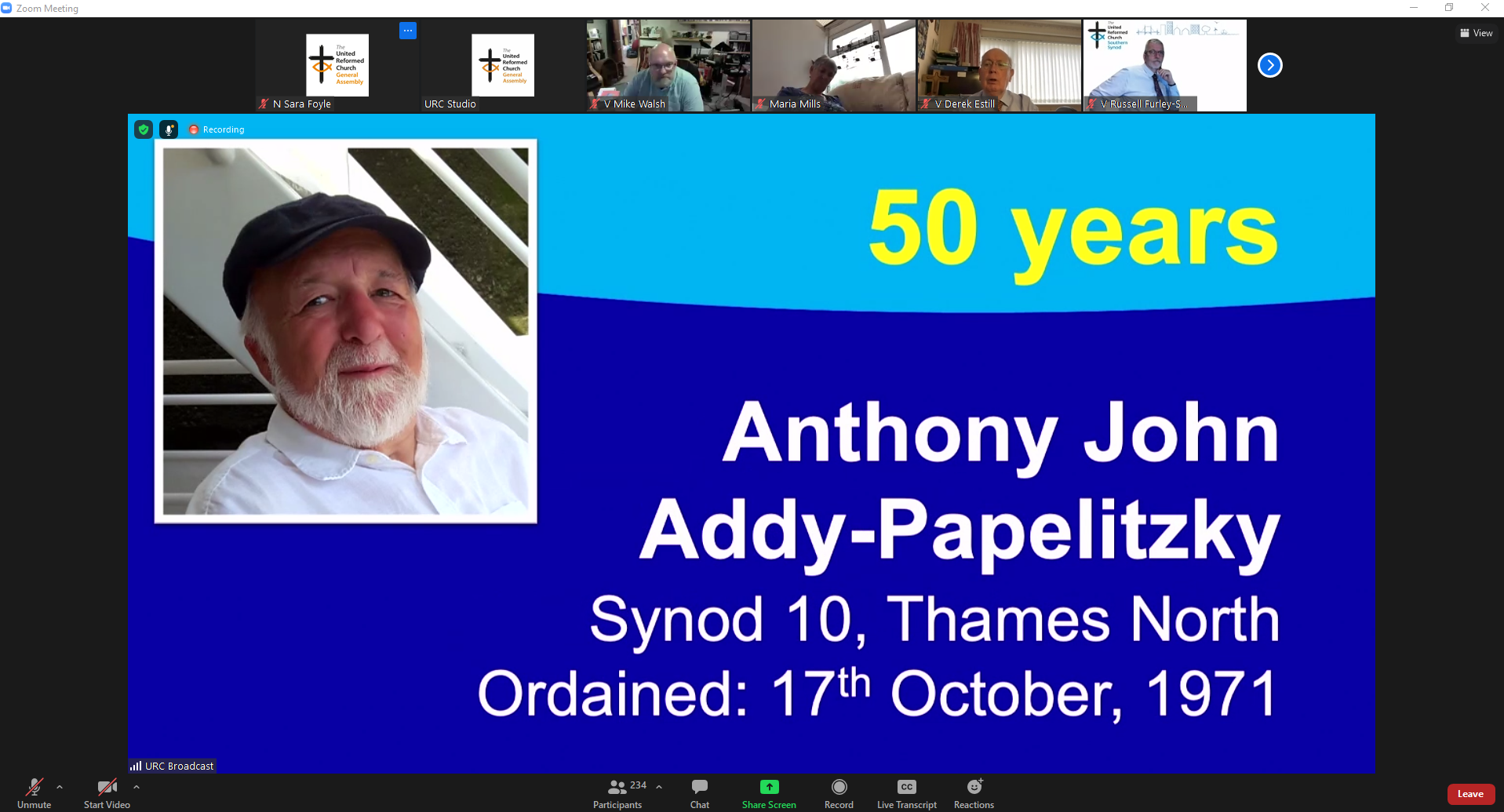 Ministers celebrating the Jubilee of their ordinations in 2021 were recognised through a PowerPoint presentation.
The Revd Basil Ernest Bridge, celebrates 70 years on ordained ministry.
The Revds Derrick Peter Ackling, Kenneth Douglas Alway-Jones, Marjorie Ayton, Arthur Jack Beeson, Anthony Gerald Burnham, David Vandepeer Clarke, Wilfred Kievill Gathercole, Michael Edmund Heard, Max Armstrong Moore, David Cranford Morgan, Barry Richard Parker, Roger Kaye Scopes, Brian John Slater, John Malcolm Smith, Harold Robert Tonks, Alan David Trinder, and Adrian John Wells celebrate 60 years of ordained ministry.
The Revds Anthony John Addy-Papelitzky, John Colbeck Durell, Graham Beresford Edwards, Anthony James Lawford Jones, Barbara Meachin, Terry Oakley, Michael John Bemrose Spencer, Brian Sadler Stone, Alan Edward Thomasson, Colin Peter Thompson, and Michael John Wear celebrate 50 years of ordained ministry.
There were no Church Related Community Workers commissioned this year.
The Revds Stephen Manyeh Ansa-Addo, Lee Barbara Battle, Sarah Louise Fitton, Ceri Ann Gardner, Susan Henderson, Aiyana Aurora Gardner-Houghton, James Hamilton, Daniel Rawdon Harris and Matthew James Rigden, were welcomed and congratulated on becoming newly ordained ministers.
The Revd Helen Everard expressed gratitude, saying: “We give thanks for those who have been newly ordained during the pandemic, and we give thanks for all those who have completed such amazing years of service.” She then read a specially written prayer by the Revd John Proctor, former General Secretary of the URC.
Paper H2: Disciplinary Policy for Office Holders
General Assembly adopted the disciplinary policy for office holders, who are not Ministers of Word and Sacraments, Church Related Community workers or paid employees.
Disciples occasionally go astray and need discipline to remind them of expected standards. Having a clear and established process in place for unacceptable actions will prevent misunderstandings and protect the office holder and the denomination, the paper from the Ministries Committee said.
Whilst rooted in the local church, there is provision for Synods also to start this new process.
The Revd Paul Whittle, Convenor of the Ministries Committee, said that complaints can go in all sorts of directions, but when it comes to office holders in Synod or congregations, there was no obvious mechanism for dealing with them when a complaint is made. “I wish this piece of business was not needed, but it is.”
The Disciplinary Policy for Office Holders described the process to be put into effect when office holders are alleged to have committed a breach of discipline, recognising the need to be fair and impartial when dealing with disciplinary issues.
The Gospel requires, the paper continued, repentance as well as forgiveness, modification of behaviour as well as personal support and care.
Following a number of clarifications and reminders about existing policies and codes of conduct, and that the policy would require refinement in due course, Nicola Furley-Smith said the committee was working towards the right policies in the right place in right order, and this was deemed to be the priority which is why it has been committee first.
John Bradbury reminded Assembly that minor amendments could be brought to later meetings of the Assembly Executive (formerly known as Mission Council) rather than amending detailed policy documents on the floor of the Assembly.
After several comments there was a motion to refer the policy back to the Committee. This was resisted by the Convenor and Secretary for Ministries, who said the policy was needed now and it was still being worked on. The motion was lost.
Alex Clare-Young proposed an amendment to prevent injustice asking that a list from the Equalities Act was included. The addition of “disability; gender reassignment; marriage and civil partnership; pregnancy and maternity; race; religion or belief; sex; sexual orientation” was accepted by the Ministries committee, and the Assembly.
After a comment by Keir Hounsome, John Bradbury said that the church was more exposed legally without the policy and that the work on it was ongoing.
Mal Breeze offered his support of the work and reminded the Assembly that if we start pulling things apart that the work of the church’s committees could be undermined.
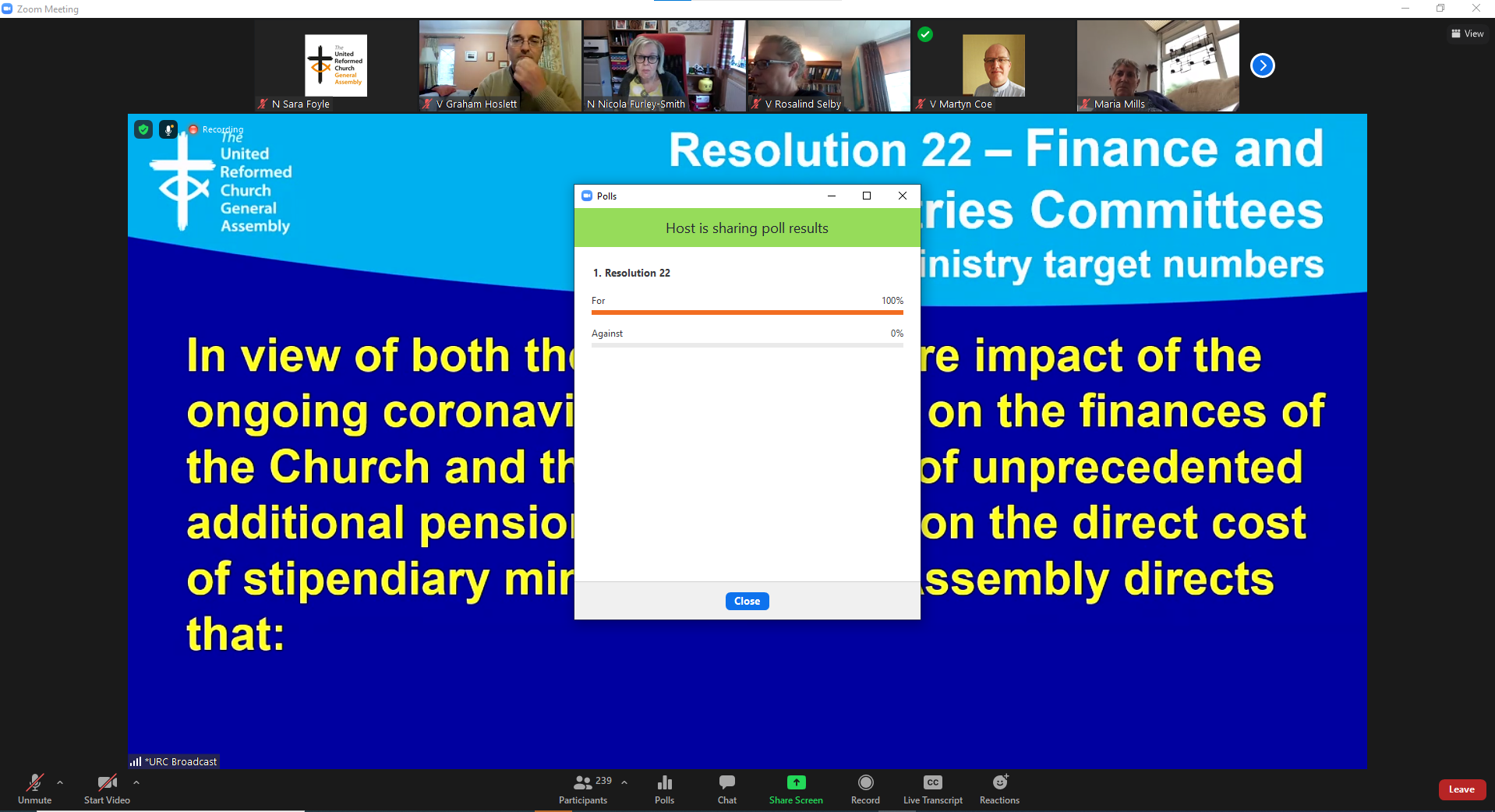 Paper G-H1: Stipendary Ministry Targets
Resolution 22 from the Finance and Ministries Committees was intended to prevent large and unforeseen cuts in the target number of ministers due to a policy previously agree by General Assembly.
Since 2012, the target number of stipendiary ministers was set so that their cost was in line with trends in the membership of the Church.
Originally intended to keep ministerial numbers in line with M&M contributions, in practice this has not happened – church membership has reduced faster than the contributions.
Increased pension costs during the next few years would dramatically cut the target number of ministers from 2022 if the policy from 2012 remained in place.
The resolution allowed time for a better solution to the 2012 policy to be addressed while avoiding any impact on the number of ministers in the short term.
Romilly Micklem told the Assembly that the contributions from the membership doesn’t cover the cost of ministers.
Paul Robinson wondered how this work would relate to the new Church Life Review Group.
John Bradbury told the Assembly that this was enabling resolution.
Rosalind Selby asked if the number ordinands would be affected and after an assurance that it wouldn’t, the resolution was carried.
Session 5
Papers T2-T4: Safeguarding Governance
General Assembly passed Resolutions 44 and 45 to make changes to the Structure and Rules of Procedure to ensure safeguarding is foundational in the Church’s journey to becoming a safer church and gave the authority for further action when necessary.
The responsibility for safeguarding lies with everyone and the changes were made after extensive consultation.
T3 – Safeguarding Committee
General Assembly agreed to disband the Safeguarding Advisory Group and established a Safeguarding Committee as a standing committee of the General Assembly. After a discussion about membership to always include a member from the National Synod of Scotland, where practice differs, the resolution was carried.
T4 – Safeguarding policy statement
General Assembly adopted the new safeguarding policy statement and commended it to church meetings, Elders’ meetings and Synods for consideration and implementation.
This policy sought to underpin safeguarding through all councils of the Church and provided an important reference point in its governance.
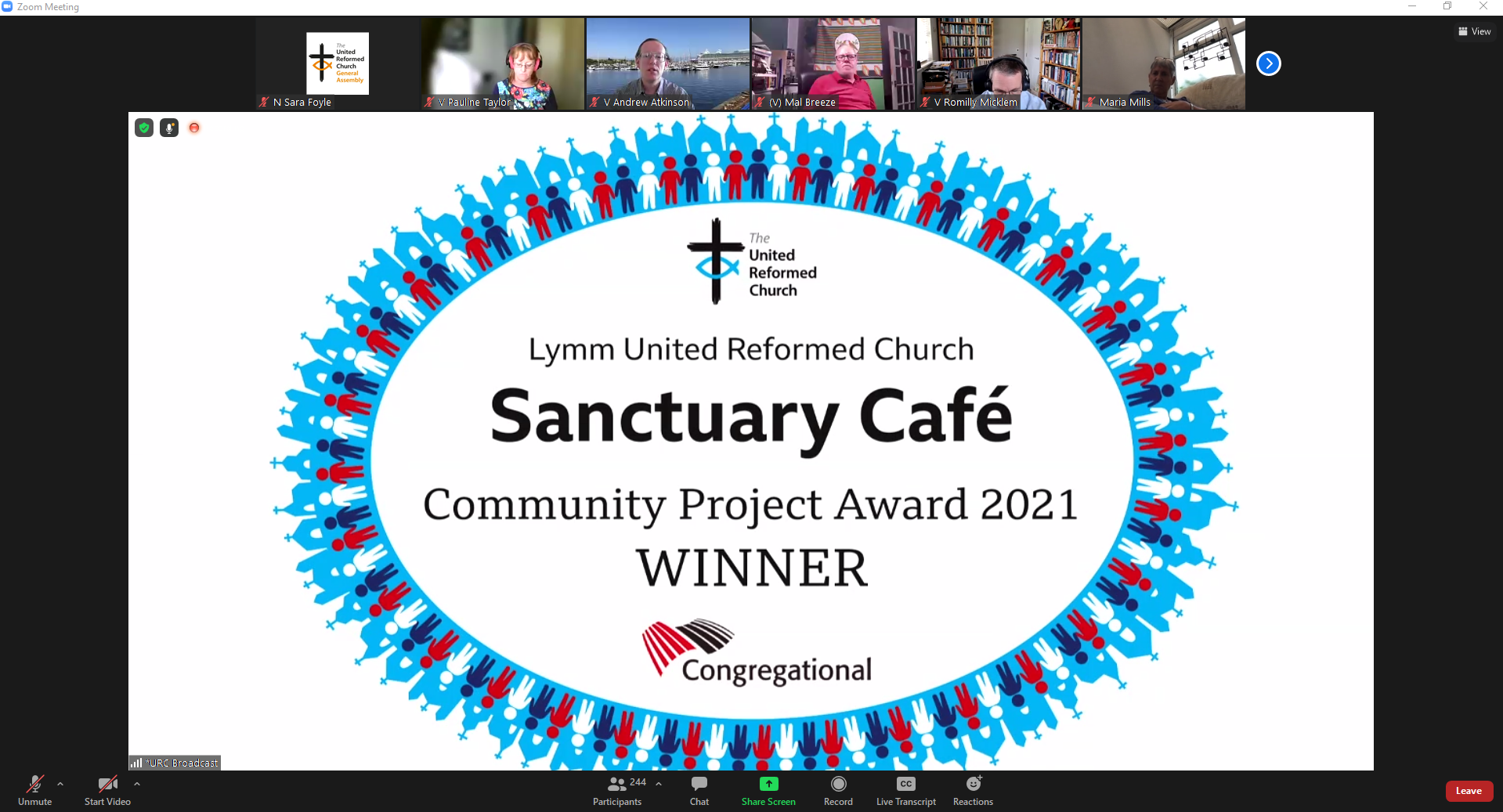 Community Awards Presentations
Margaret Slater, Head of Marketing at Congregational, introduced to the Assembly the winners of the 2020 and 2021 Community Project Awards, a scheme run by the United Reformed Church in collaboration with Congregational and Reform magazine.
The Awards recognises inspiring and innovative community projects in local churches with a URC connection, ones which meet a local demand and have a positive effect on community life.
“One of the positives of the pandemic,” said Margaret, “is that we’ve seen how important it is to be part of a community and how much we need to interact with other people, so the Community Awards are even more significant this year.” She said that all the winners had a lot to be proud of.
This year’s five winners are:
- Spire Cafe, a church-based community cafe at the Spire Church, Farnham, a URC and Methodist LEP in Surrey
- Chorley Repair Cafe, which repairs items and shares repair skills with the community at Chorley URC
- Sanctuary Cafe, a cafe, bookshop, events centre and community hub at Lymm URC near Warrington
- Messy Vintage, a service of activities and worship for people held at Shrewsbury URC
- The Food Project, which provides free food to people who need it, at Lea Road URC, Wolverhampton.
The winners each received prizes of £2,000 to further their work.
There will be full reports on each project in coming issues of Reform and videos about the projects are available on the URC YouTube channel.
Paper X1: Modern-day Slavery
The Revd Steve Faber, Moderator of the West Midlands Synod, presented two resolutions to General Assembly relating to the creation of a denominational policy statement on the issue of Modern-day Slavery.
The first (resolution 50) concerned the research and preparation of a proposed policy for Church House and Assembly business that is to be presented to the Assembly Executive (formerly Mission Council) or General Assembly no later than the Assembly meeting in 2023. The second (resolution 51) tasked the Safeguarding Advisory Group/Committee to draft clear guidance that will help churches and individuals identify those subjected to the abuse.
“There can be no doubt that Modern-Day Slavery is one of the biggest injustices active in our world today. One estimate suggests it is the most profitable illegal activity in the world only after the supply of narcotic drugs,” Steve said. “Precise figures are impossible to obtain, precisely because this is work carried out illegally, but the International Labour Organisation estimate that right now there are more people in forced servitude, forced sex work, forced marriage, and subject to human trafficking including organ harvesting than the total of all who were captured and sold through the Transatlantic Slave Trade. General Assembly is rightly and very properly concerned with the legacies of that slavery. We must, though, also be concerned about those living through these abuses now.”
Steve said that as General Assembly is being asked to consider proposals about divesting from companies involved in human rights abuses in Israel and the Occupied Palestinian Territories, so it should be concerned about divesting from companies involved in modern-day slavery.
Steve then moved onto resolution 51 and began by explaining to General Assembly how the West Midlands Synod has helped its world church partner in West Bengal, India, to fund the construction of a hostel for children from impoverished families at risk of human trafficking, and over several years it has been able to contribute towards their housing and education. The Synod has also been able to partner with the Church of North India to safeguard vulnerable children.
“But,” continued Steve, “modern-day slavery also affects our own communities, from the inner-city to the suburban to the rural – it is present in some form or another in almost every community in the UK.
“We know that car washes and nail bars as well as domestic servitude are frequent areas of exploitation and slavery in the UK, but as listeners to The Archers will know, it is much broader than something that happens to migrant communities through international trafficking. White British people are also subject to forced labour. The breadth and depth of the issue are horrifying.”
Steve said much more information and guidance was needed for churches to help them identify the abuse that is often happening on our doorsteps but hidden in plain sight.
Steve was supported by Mervyn Davies, Finance Officer for the West Midlands Synod, who called the incidence and prevalence of modern-day slavery a “shocking injustice”. Mervyn explained how we could be complicit in the abuse by not being rigorous in our spending and investing habits, naming the clothes we where to the cocoa we have before bad as opportunities.
Mervyn also explained how as a finance officer, the Institute of Chartered Accountants, of which he is a member, has been training people in writing modern-day slavery statements since 2016. Mervyn highlighted and congratulated the steps the URC has already taken on the issue from which it can build saying: “The investments of URC Trust and Ministers’ pension are with CCLA who have already signed up to the Find it, Fix it, Prevent It initiative to not invest in companies tainted by slavery, after making enquiries of Synod’s investment managers they too, last month, have now signed up; the URC has already committed to pay the Real Living Wage; and many members of the denomination already buy Fairtrade.
Steve and Mervyn were thanked from the floor for bringing this important subject to General Assembly and both resolutions passed with virtually no objections.
Session six
Paper E1 and E2 Equalitiies Committee
The Revd Anne Lewitt, Convenor of the Equalities Committee, presented Paper E1: Equalities Committee and Paper E2: Affirmative action towards an anti-racist church.
Anne did not move a resolution in Paper E1 but shared with General Assembly a summary of the Committee’s work since a previous report was made in 2020.
Anne advised that the remit of the Equalities Committee is to remind the denomination that equality is enshrined in its theology, life and work, and to challenge the practice of the URC where appropriate, and that the URC affirms its commitment to show the same openness to all people in today’s world as Jesus did in his day.
As such, Anne highlighted that a ‘Diverse Gender Identities and Pastoral Care’ was recently mailed out to ministers and expressed delight at proposals in Children’s and Youth Work Committee’s Paper B2 about making committee meetings accessible to all. More copies of the booklet are available. Anne directed people to contact herself or Karen Campbell to receive a copy, or visit the Church of Scotland’s website where it can be downloaded for free.
Four resolutions were presented in Paper E2 which focused on the addressing the underrepresentation of Black and ethnic minority people in Assembly-appointed posts.
“The very obvious racial imbalance in positions of high visibility and influence within the URC is both a concern in itself and has a wider influence in the denomination.” Anne said.
“We therefore bring these resolutions as a small but important step on the road towards becoming, and being seen to become, an actively anti-racist church. They represent affirmative action. Something which we can do and should do.”
A lively discussion was held, which included Andy Middleton, the URC’s legal advisor, reminding General Assembly to take acre in wording any policy.
The Revd Nicola Furley-Smith, URC Secretary for Ministries, confirmed that her committee and Education and Learning Committee was already engaged in developing a programme to develop skills in people who are considering applying for an assembly-appointed post.
Karen confirmed that that the small group, as stipulated in the paper, would seek to compliment work already being undertaken. Some Assembly members sought clarification on how nominations and applications were made.
The Revd Dr John Bradbury, URC General Secretary, clarified the main two ways; that people are recruited to Assembly-appointed posts through nominations or by direct applications, that these appointments are advertised in Reform magazine, the URC website, social media, and circulated direct to Synods, who in turn circulate the vacancies through their networks to ministers and so forth.
John did, however, say that most applications whether nominated or directly applied for were from middle-aged white males, which the four resolutions seek to address.
After some minor amendments to the wording, resolutions 15 and 16 passed substantively.
More discussion took place about Resolution 17 were some felt that the meaning behind the resolution was lost, that changes to the wording would diminish the fact that the paper was actively seeking to address equipping Black and minority ethnic people with experience and skills, where others felt the fact that the paper was seeking to do just that was offensive in that it assumed that Black and minority ethnic people did not already have the required skills.
The proposers of the paper were happy to work further on the issues behind the resolution 17 and withdrew it. Resolution 18, regarding the small group reporting back to General Assembly in 2022, was passed.
Session seven and eight to follow.
Posted in Latest News.
Comments Off on General Assembly day two round up: 10 July 2021
General Assembly day one round up: 9 July 2021
 General Assembly, the key-decision making body of United Reformed Church (URC), opened on 9 July. Due to the Covid-19 restrictions, the meeting was held digitally.
The 2021 General Assembly of the United Reformed Church began with the Constitution of Assembly in prayer by the Moderator of Assembly, Peter Pay.
Posted in Latest News.
Comments Off on General Assembly day one round up: 9 July 2021
Make COP Count Parliamentary Event
Ahead of COP26 in November 2021, the interfaith initiative Make COP Count gathered faith leaders and parliamentarians together to explore the role of faith communities in encouraging an ambitious and effective climate summit, in partnership with the all-party parliamentary groups … Continue reading
Posted in Latest News.
Comments Off on Make COP Count Parliamentary Event
New resource to help children explore Nicaragua
 The United Reformed Church Children’s and Youth Work team has teamed up with Commitment for Life to publish a new resource to help children and young people engage with Nicaragua.
‘Go with Greta to Nicaragua’ comprises six sessions aimed at five to 11-year-olds while ‘#connect2 Nicaragua’ is aimed at 11 to 14-year-olds.
Posted in Latest News.
Comments Off on New resource to help children explore Nicaragua